Glossary
The Natural Resources Transparency Commission (NRTC) is an independent body, structurally unaffiliated with government units, tasked with executing the membership obligations of the Republic of Iraq under the Extractive Industries Transparency Initiative (EITI). The Commission ensures the implementation of EITI international principles and standards aimed at enhancing transparency in the management of the oil, gas, and mining sectors, reducing corruption and poverty, fostering economic development, and improving living standards.
Definitions
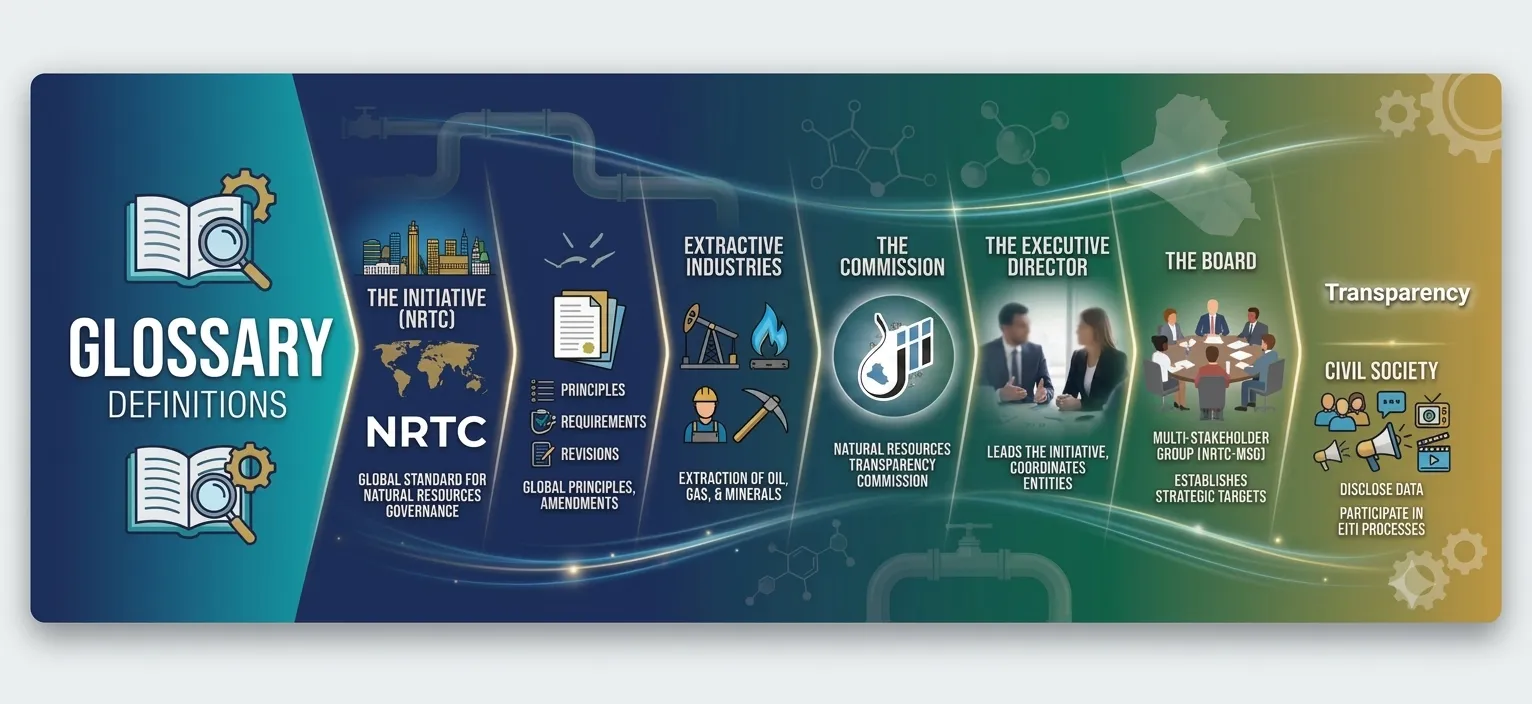
The Initiative (EITI): The Extractive Industries Transparency Initiative (EITI), headquartered in Oslo, Norway, is the global standard for the good governance and transparency of natural resources (oil, gas, and minerals). The Republic of Iraq joined the initiative in 2012.
EITI Standards: The global principles, requirements, and standards adopted by the EITI, including the June 2023 amendments and any subsequent revisions.
Extractive Industries: The set of operations related to the extraction of oil, gas, and minerals from the subsoil, as well as downstream/subsequent activities.
The Commission: The Natural Resources Transparency Commission (NRTC) established pursuant to this Executive Order.
The Executive Director: The senior official responsible for leading the initiative, representing the Republic of Iraq in its conferences and meetings, and holding full authority to manage the implementation of EITI standards and coordinate among relevant entities within and outside Iraq.
The Board: The Board of Trustees of the Natural Resources Transparency Commission, serving as the Multi-Stakeholder Group (MSG) according to EITI terminology.
The Government: The Government of the Republic of Iraq, responsible for implementing EITI standards and resolving any operational obstacles in accordance with the 2023 EITI Standard.
International Extractive Companies: Operating companies in the oil, gas, and mining sectors—comprising both private companies (international and local) and state-owned enterprises (SOEs) affiliated with the Ministry of Oil and the Ministry of Industry and Minerals. These entities are required to disclose data and actively participate in EITI processes under the 2023 EITI Standard.
Civil Society: Non-profit individuals and non-governmental entities duly registered under the laws of the Republic of Iraq—such as NGOs, media outlets, professional associations, and syndicates—pursuant to the requirements of the 2023 EITI Standard.
Structure of the Commission:
Board of Trustees (Multi-Stakeholder Group - MSG): Oversees the implementation of EITI standards and establishes strategic targets that reflect national priorities for managing the oil, gas, and mining sectors.
National Secretariat: Operates under the direct daily supervision of the Executive Director, managing the Commission's day-to-day operations. It comprises:
a. Permanent Staff: Personnel assigned from the government entities represented on the Board.
b. Action Team (Support Team): Subject-matter experts nominated by Board-represented entities and relevant authorities to provide support to the Board through periodic meetings.
c. Consultants: External advisors contracted directly by the Board.
Board of Trustees (MSG) Composition
The Board of Trustees consists of the Chairman, the Vice Chairman, and sixteen members appointed for a renewable four-year term, with due consideration given to gender balance:
Chairman: Minister of Oil.
Vice Chairman: Executive Director (ex officio).
Government Representatives (6 Members): Officials holding the rank of Director General or above, nominated by the Ministry of Planning, Ministry of Oil, Ministry of Finance, Ministry of Industry and Minerals, the General Secretariat for the Council of Ministers, and the Central Bank of Iraq.
Extractive Sector Representatives (5 Members):
Two members representing international companies in Iraq (Regional Director or Branch Manager rank).
Two members representing SOEs under the Ministry of Oil (Director General rank).
One member representing SOEs under the Ministry of Industry and Minerals (Director General rank).
Civil Society Representatives (5 Members):
Three representatives from NGOs (Head of Organization rank), selected from legally registered organizations under NGO Law No. 12 of 2010.
Two representatives from officially registered syndicates and professional associations (Head of Union/Syndicate rank).
Government nominees on the Board are subject to approval by the General Secretariat for the Council of Ministers.