Who we are
The Natural Resources Transparency Commission (NRTC) is an independent body, structurally unaffiliated with government units, tasked with executing the membership obligations of the Republic of Iraq under the Extractive Industries Transparency Initiative (EITI). The Commission ensures the implementation of EITI international principles and standards aimed at enhancing transparency in the management of the oil, gas, and mining sectors, reducing corruption and poverty, fostering economic development, and improving living standards.
Transparently
In alignment with national commitments and state governance priorities, the Natural Resources Transparency Commission (NRTC) operates as an independent authority mandated to execute Iraq’s obligations under the Extractive Industries Transparency Initiative (EITI) and advance global governance standards.
The stewardship of national sovereign wealth—spanning oil, gas, and mineral sectors—is fundamentally a public trust and the foundation of sustainable economic development. To uphold this mandate, the Commission drives systematic disclosure frameworks, ensuring comprehensive, real-time reporting on revenues, contractual agreements, and financial flows generated across the resource management lifecycle.
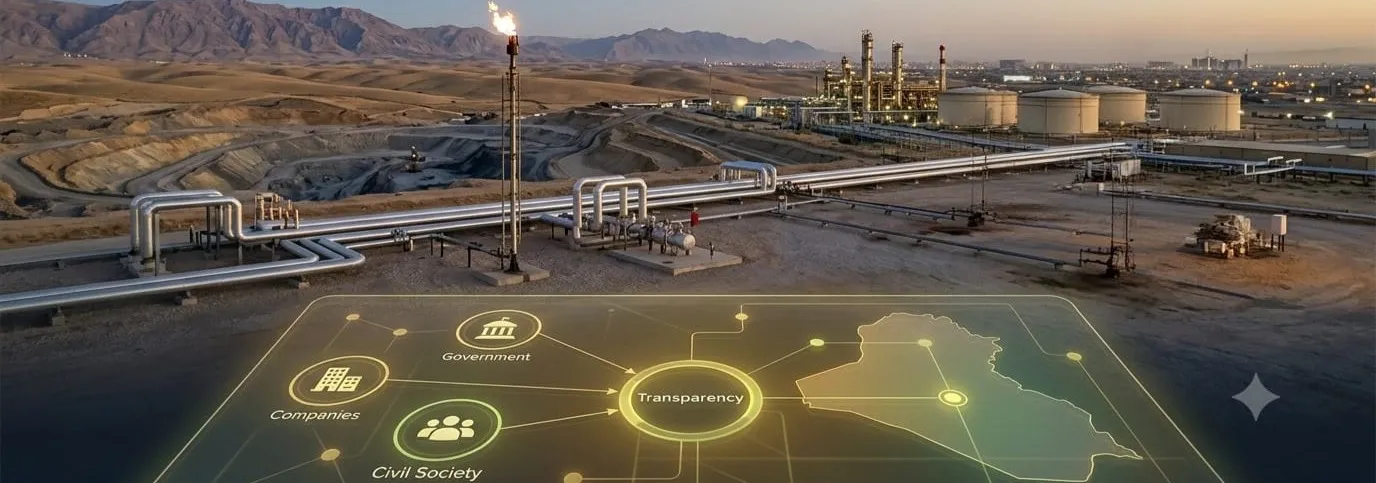
Operating through a multi-stakeholder model, the NRTC bridges structured collaboration among government institutions, national and international extractive companies, and civil society organizations. This institutional integration safeguards accountability, combats corruption, and monitors the environmental and social impacts of resource extraction to maximize tangible economic value for the public.
Transparency serves as our core operating strategy to foster institutional trust, establish measurable national impact indicators, and reinforce Iraq’s position as a principal benchmark for governance, integrity, and sustainable resource management globally.
Definitions
The Initiative (EITI): The Extractive Industries Transparency Initiative (EITI), headquartered in Oslo, Norway, is the global standard for the good governance and transparency of natural resources (oil, gas, and minerals). The Republic of Iraq joined the initiative in 2012.
EITI Standards: The global principles, requirements, and standards adopted by the EITI, including the June 2023 amendments and any subsequent revisions.
Extractive Industries: The set of operations related to the extraction of oil, gas, and minerals from the subsoil, as well as downstream/subsequent activities.
The Commission: The Natural Resources Transparency Commission (NRTC) established pursuant to this Executive Order.
The Executive Director: The senior official responsible for leading the initiative, representing the Republic of Iraq in its conferences and meetings, and holding full authority to manage the implementation of EITI standards and coordinate among relevant entities within and outside Iraq.
The Board: The Board of Trustees of the Natural Resources Transparency Commission, serving as the Multi-Stakeholder Group (MSG) according to EITI terminology.
The Government: The Government of the Republic of Iraq, responsible for implementing EITI standards and resolving any operational obstacles in accordance with the 2023 EITI Standard.
International Extractive Companies: Operating companies in the oil, gas, and mining sectors—comprising both private companies (international and local) and state-owned enterprises (SOEs) affiliated with the Ministry of Oil and the Ministry of Industry and Minerals. These entities are required to disclose data and actively participate in EITI processes under the 2023 EITI Standard.
Civil Society: Non-profit individuals and non-governmental entities duly registered under the laws of the Republic of Iraq—such as NGOs, media outlets, professional associations, and syndicates—pursuant to the requirements of the 2023 EITI Standard.
Under Executive Order No. (86), Mr. Alaa Rasool Muhyi Al-Din was appointed as Executive Director and representative of the Republic of Iraq to the EITI.
Structure of the Commission:
Board of Trustees (Multi-Stakeholder Group - MSG): Oversees the implementation of EITI standards and establishes strategic targets that reflect national priorities for managing the oil, gas, and mining sectors.
National Secretariat: Operates under the direct daily supervision of the Executive Director, managing the Commission's day-to-day operations. It comprises:
a. Permanent Staff: Personnel assigned from the government entities represented on the Board.
b. Action Team (Support Team): Subject-matter experts nominated by Board-represented entities and relevant authorities to provide support to the Board through periodic meetings.
c. Consultants: External advisors contracted directly by the Board.
Board of Trustees (MSG) Composition
The Board of Trustees consists of the Chairman, the Vice Chairman, and sixteen members appointed for a renewable four-year term, with due consideration given to gender balance:
Chairman: Minister of Oil.
Vice Chairman: Executive Director (ex officio).
Government Representatives (6 Members): Officials holding the rank of Director General or above, nominated by the Ministry of Planning, Ministry of Oil, Ministry of Finance, Ministry of Industry and Minerals, the General Secretariat for the Council of Ministers, and the Central Bank of Iraq.
Extractive Sector Representatives (5 Members):
Two members representing international companies in Iraq (Regional Director or Branch Manager rank).
Two members representing SOEs under the Ministry of Oil (Director General rank).
One member representing SOEs under the Ministry of Industry and Minerals (Director General rank).
Civil Society Representatives (5 Members):
Three representatives from NGOs (Head of Organization rank), selected from legally registered organizations under NGO Law No. 12 of 2010.
Two representatives from officially registered syndicates and professional associations (Head of Union/Syndicate rank).
Government nominees on the Board are subject to approval by the General Secretariat for the Council of Ministers.
Mandate & Responsibilities of the Board
The Board is tasked with the following duties:
Discussing, approving, and tracking the implementation of the Work Plan, covering all EITI-related activities in the oil, gas, and mining sectors to ensure full compliance with EITI standards. This includes approving transparency reports, annual progress reports, impact monitoring plans, dissemination/media strategies, and the operational budget, aligned with national priorities.
Approving the Commission’s budget and submitting funding requests to government entities represented on the Board.
Reviewing, approving, and amending procurement contracts required for operational plans, overseeing all contractual phases—from Terms of Reference (ToR) and RFP issuance to evaluation, award, and execution.
Contracting independent experts and consultants outside governmental agencies.
Monitoring, reviewing, and approving the production of EITI Transparency Reports, collaborating with government agencies and international companies to overcome data-collection hurdles.
Forming permanent and ad-hoc technical committees nominated by member entities to support the Commission’s mission.
Establishing effective communication channels between Board members and their broader constituencies to foster wider stakeholder engagement.
Preparing and submitting annual financial statements to the Federal Board of Supreme Audit.
Responsibilities of the National Secretariat
The National Secretariat is responsible for:
Drafting work plans, annual budgets, Terms of Reference (ToR), procurement contracts, and progress reports for Board review and approval.
Coordinating with the International EITI Secretariat, member countries, the World Bank, and other international/local partners regarding capacity building, standards analysis, scoping studies, and technical cooperation.
Organizing Board meetings, managing administrative support, archiving disclosure forms, meeting minutes, and reports, and ensuring timely public access to information.
Coordinating preparation for EITI Validation assessments.
Facilitating the independent administrative processes required for publishing transparency reports.
Managing data portals, the official website, social media platforms, media relations, and press releases.
Organizing the Annual EITI Conference to present progress reports, address sector challenges, and assess the initiative’s impact on Iraq’s extractive governance and public livelihood.
Powers of the Executive Director
The Executive Director exercises the following administrative and financial authorities:
Representing the Republic of Iraq at relevant international and governmental forums and managing inter-agency coordination.
Sourcing technical, administrative, and capacity-building support from local, government, and international partners for the Board, Secretariat, and relevant stakeholders.
Exercising administrative authority over Secretariat operations and work plan execution, including secondment requests, committee formations, and signing official contracts and correspondences.
Exercising financial and disbursement powers under the approved annual budget, including forming procurement committees, signing payment vouchers, bank transfers, and approving personal declarations when official invoices are unavailable.
Designing the Secretariat's organizational structure and defining staff job descriptions.
Impact, Innovations, and Policy Reforms (EITI International Platform)
In 2025, two studies supported by the World Bank – an assessment of SOE disclosures against the EITI Standard and a governance review benchmarked against the OECD Guidelines on Corporate Governance of SOEs – provide new analysis of state participation and SOE governance in Iraq’s extractive sector, identifying gaps in transparency and financial practices and offering recommendations aligned with international good practice.
Late 2023, Iraq’s Deputy Prime Minister and Minister of Oil instructed the SOEs to publish the research and exploration contracts and audited financial statements and share copies with EITI Iraq.
In 2021, the Government of Iraq signed an agreement with the World Bank and the European Union to strengthen its institutions and mechanisms of fiscal accountability and oversight at the federal and subnational levels. Among others, it will support transparency and accountability in the oil sector through EITI.